SuperHero's Guide to Communication


Introduction
Once upon a time, I wasn’t a good listener. I didn’t have a lot of empathy because I didn’t get a lot growing up, and it didn’t come easily or naturally to me. So why do people pay me money to be heard, feel cared for, and accepted?
Because I learned how! And you can too!
That’s what I tell my clients, especially my couples in therapy when they’re doing the worst job ever of listening but a great job at defending, explaining, justifying, and distancing themselves from their partner.
This guide is what I’ve learned as a therapist.
So put on your magic decoder ring and ramp up your communication skills to SuperHero status!
Listening
There are many different types of listening. Listening to hear or understand, to problem solve, support, to hold space. How and the ways you listen can be your greatest SuperPower. Think of how you may do this at work but not at home, or at home but not at work. Different environments may call on us to listen differently. But what is at the heart of listening? What does it mean to be listened to?
As many of us are busy, multi-tasking, not fully present, we may listen half-heartedly and people receiving our listening feel that. I know I’ve had friends reflect my lack of presence as I’m driving, texting, or doing other things and not really there with them. I remember a quote that reflecte “the greatest gift we can give someone is listening and allowing them to empty.”
Sacred Listening
What makes relationships sacred and how does it apply to listening?
Relationships, I believe, are a spiritual practice as it requires a number of elements such as acceptance, forgiveness, surrender, and letting go – difficult and powerful virtues. They are an opportunity for growth and not just personal gain. They require deep reverence, unconditional love, commitment and seeing the divine within your partner.
Sacred listening is the holding of the relationship as sacred which allows listening from a deeper place. It is listening from the heart. Remembering that I care about this person, and want to lead with kindness, presence, and respect. To give the speaker the benefit of noble intent is felt deeply. In personal relationships, it’s remembering that I love this person.
When we remember that the person we are listening to is important, respect-worthy, and needing of our attention, something changes inside.
It doesn’t mean you may not have boundaries, but to do it respectfully.
.

Tip: It gets easier with practice!
Practices:
Before any communication, allow yourself to drop into your heart and practice the simple religion of kindness.
Active/Reflective Listening

This is the #1 reason people pay me a lot of money. I remember when I was practicing to be a therapist, a friend and potential romantic partner was feeling very down. I practiced my active listening skills and only reflected what I heard him say and asked deepening questions about what I was hearing. While it felt unnatural to me to communicate in this way, the next day he told me how powerful it was to talk with me and how he felt much better.
He felt understood and seen, and maybe more importantly – accepted.
‘I’ve learned that people will forget what you said, people will forget what you did,
but people will never forget how you made them feel.’ —Maya Angelou
Tip: Repeating back what your partner says, with “love’s ear” - an ear for their emotions keeps you out of defensiveness, explaining, or fixing. Explaining/ expanding awareness can come later. It also buys you time to relax into listening, hearing, and being compassionate.
Listening and acknowledging other’s feelings and perspectives does not invalidate your own!
Offer them compassion and care for their experience, no matter how you feel about the situation. Focus on their emotional experience. You might ask them if they want your help and be willing to hear no. And just listen.
The video, It’s Not About the Nail, portrays this in a hysterically funny, poignant way.

Watch It’s Not About the Nail here.
Tip: Only express how it feels for you to hear what they are saying when they feel complete in the process. Take time before offering any explanations, if at all. Evaluate the value of doing so.
Practices:
Let yourself revisit a communication that didn’t go well with your beloved or a work colleague. Invite yourself to go back and reflect their position, emotions, and needs/requests.
In your next conversation, notice how it feels to let go of your own reactions and needs, even if for a short time.
Cupcaking – The Art of Sweetness

Momma told me you can catch more flies with honey
than you can with vinegar.
Cupcaking is a charming twist on this age old teaching I learned from a young man in a court-mandated anger management class. He was fluent in the Art of Cupcaking and used it to sweeten the pie when making requests, talking about difficult topics, or getting out of the doghouse. While it can feel manipulative and smooth-talking if overdone, a little sugar goes a long way.
Tip: It has to be authentic!
Practices:
Practice using sweetness instead of vinegar.
Next time you start up a difficult conversation, start with some sugar!
Have a soft startup. How a conversation starts is a huge predictor of how it will end.
The Love Sandwich

The Love Sandwich may be confused with the Shit Sandwich. What makes one or the other?
The Love Sandwich emphasizes staying in communication while expressing a boundary, saying no, or speaking about a difficult topic. The middle is not shit if it’s important self-care, setting a boundary, constructive feedback, and/or tending to important savory topics. If it’s critical or snarky, it’s a Shit Sandwich.
The Love Sandwich includes:
· A piece of bread to start – appreciation and acknowledgement of person’s request or interest
· The meat – your No, boundary, difficult message, etc.
· Another piece of bread – acknowledging the disappointment or hurt feelings one might feel in response to “the meat”. Include more love, counter-offer, appreciation, etc.
“Honey, I really appreciate that you want to make love with me (spend time, etc.), and I really need to get this project done for tomorrow and I’m feeling exhausted. I know you may be disappointed AND I’d LOVE to make love tomorrow night and am super excited to feel your desire for me. Will you take a rain check?”
How would this make you feel?
Disappointed yes, but cared for, appreciated, desired, and looking forward to when it will happen!
When someone just tells you No!, or gives you the message, “What are you crazy?”, how does it feel?
Practices:
Practice setting a boundary or saying no to someone using the Love Sandwich.
Blocks to Listening

Sometimes my clients say to me, “this is the only place I can feel heard,” why is that? Because I let them speak without interruption and run interference on their partners when they interrupt. Interrupting is just one form of blocking listening.
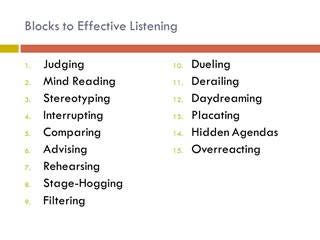
Blocks to listening are habits or communication things that we do that take away from the speaker feeling heard and understood. When done, they can take away from deepening opportunities and learning more about what the speaker is thinking and feeling. Sometimes we think they’re in service of caring, however, even well intentioned problem solving can leave someone feeling inadequate or missed. Our particular blocks to listen often stem from our own reactivity, defensiveness, or discomfort with what the speaker is expressing.
Most of us have a top few faux pas’ we do regularly that takes away from people feeling good about their conversations with us.

Practices:
Identify your top blocks to listening. Consider how they affect your partner and derail what you want from a communication.
Reflect on what is uncomfortable about what the listener is saying that makes you want to move away from their expression and solve, placate, or dismiss them.
Ultimately, stop doing any or all of these that you do. Go back to Sacred and Active Listening.
Tell your partner what you want from their listening before your share. Like, “I’d really just like you to listen and reflect back to me.” Or “Can you help me problem solve this situation?”
What’s Beneath the Iceberg - What’s Not Being Said in What’s Being Said

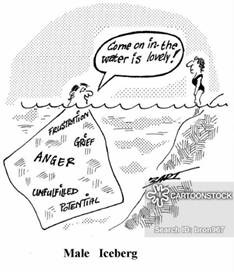
I liken human communications to icebergs. There’s a little bit above water that is what we know and what we show. The rest under the water is either hidden to us in the shadow or we choose not to reveal it. Whether conscious or not, it leaves our partners, family, and colleagues constantly bumping into what’s under the water.
Often we can get caught in the trigger/defensive response pattern when we really feel surprised, confused, unaware of what’s going on. And when I slow people down, and ask deepening questions or why something matters, or what it means to them, the deeper unknown memories and feelings are exposed and can be surprising.
It’s often what’s under the iceberg that causes problems – the unknown, unowned, unexpressed, or uncared for when it does get revealed.
An Example:
I recently sat with a couple where the wife was upset and snarky with her husband when he got upset with her for talking about his friend’s “inappropriate” behavior. She flipped him the bird and stormed upstairs in a snit. In excavating what was under the iceberg, her husband got in touch with his deeper feelings about her appointing herself as the VP of Appropriate Behavior and how painful it was for him to feel like he couldn’t be loved or accepted for who he was. How she constantly reprimanded him about what behavior of his was acceptable or unacceptable.
Unwittingly, she touched into a core wound and his basic need for acceptance and unconditional love from her. It was no longer about his friend but his own painful feelings of feeling judged and subjugated to “inappropriate” that caused the upset. Upon uncovering this, she was surprised, compassionate, and shifted out of her hurt to feeling surprise, humility, compassion and care for his pain. Instead of escalation and separation, there was understanding and closeness.
Tip: Slowing down, asking questions, deepening into understanding goes a long way in uncovering deeper truths, raw spots, and vulnerabilities.
Practices:
Before responding and reacting to another’s expression (even if negative), become an explorer. Ask deepening questions about how they feel, what’s going on. Stay with them until something shifts in them or in you.
Making Requests

A great adage I learned in my communication training was:
Turn Gripes Into Requests
Why is it so hard sometimes to make requests? Because they can be super vulnerable -> you might hear no, you might not be used to making yourself vulnerable to the needs and nourishment from others. Maybe you’ve asked a number of times and are tired of it, or don’t think you’ll get it. Many of these add up over a lifetime and can lead to defensive patterns of avoiding asking altogether because as a child it was just too painful. All of these lead to getting less of your needs met over time.
Tip: SuperPower Philosophy: Ask for 100% of what you want, and expect to hear “No” sometimes.
And disappointment is frigging painful. I hate disappointment. And it’s a muscle, like vulnerability, to strengthen and use as discernment. If your partner meets little of your needs, or is constantly saying “No”, you have to evaluate why your partner may be emotionally or sexually disengaged and speak with them about it.
Other things to consider include:
· Am I making a request or making a demand? Does my partner have the right to say no?
· How important is this need?
· How can I get this need met in other ways?
· How can I talk to my partner about how I’ll get this need met?
The other aspect of requests is responding to requests. Sometimes requests are really demands barely being masked as a request. Energetically, they feel different.
Three possible answers to a true request are: Yes, No, and Maybe. If you don’t feel like you can say No or Maybe, then maybe it’s really a demand and you should discuss this with your communication partner. What is the impact of you saying No? Are your fears real or are you responding in ways you’ve learned in your family or as a child that aren’t necessarily appropriate as a well-functioning adult.
Can you clearly own your Yes and No. Sometimes No is a complete sentence. Other times, an explanation or renegotiation is warranted.
Practices:
Practice making a request.
Notice what happens when you hear a No or Maybe. How do you handle disappointment? Can you ask for a Love Sandwich?
Practice saying No if you usually say Yes, or Yes if you usually say No.
Conflict Styles
Many people come to therapy because of difficulty with conflict and want to live in a world without it. Unfortunately, whenever there’s two or more people involved there are differing needs and desires. Even when there’s only one (you!), there are internal conflicts between different parts that may want to get fed. My inner child wants more play and spontaneity, my Miss Enterprise wants to work and feel productive. How do you balance them? Avoiding even internal conflicts can leave you feeling cut off and distant from your most precious needs.
Four basic conflicts styles are below. Consider which is your prominent style or which ones you use in different environments. We can often have one style at work, and another at home.
Passive: Everyone’s needs are more important than your own. You’re passive and compliant until you feel resentful that your needs aren’t being met. This style often blends into Passive Aggressive (see below). “Oh, whatever you want for dinner is fine.”
Aggressive: Your needs are more important than anyone else’s and you’re willing to bully your way into getting it. Pro: You get your needs met most of the time. Con: You wear other’s out and you feel their resentment.
Passive Aggressive: You pretend to go along, then do something to sabotage. It’s an inability to outright express a no or your resentment leads to indirect negative acting out.
Assertive: Everyone’s needs are important though some compromise may be required at times. You can assert your desire “I’d like Italian”, can say No, make requests, and manage your disappointment in healthy ways.
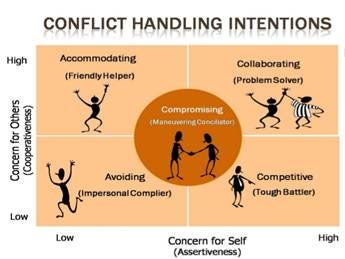
Another perspective looks at the self/other axis and distinguishes between avoidance, accommodating, competitive and collaborating with compromise in the middle. Where do you fall generally in conflict resolution on the self/other axis?
Tip: You have to be in conflict to resolve it.
Practices:
Consider your style and journal about the impact of your style on you and others. How did this style develop?
Practice being assertive by making clear choices and owning your Yes and your No. Notice any discomfort before or after you are more assertive.
Avoiding conflict is not peace, it’s managing tension.
Checking In
Checking in is a great communication practice. It suggests you care about how someone is doing, a project is going, how you are in relationship to someone or something.

“Hey I wanted to check in about your expectations once we get to Maui. What might you want to do?”
“I wanted to see how you were doing after our discussion on my needing more intimacy.”
Checking in allows for clarification of expectations and reduces disappointment or makes it more explicit and able to be dealt with rather than going into the iceberg for later thawing.

Practices:
Notice if there’s something you’ve been avoiding checking in about because maybe you don’t want to know the answer? Be brave and ask anyway. Cultivate the SuperPower of hearing and holding the truth!
Whose Social Etiquette Book is it Anyway?
I hear all the time, “they should have known to ….”, “even an idiot knows …”. Well according to whose book of social etiquette is it written that one shouldn’t eat pumpkin seeds in the shell in the living room? Or what’s appropriate to wear, or share, or …

We seem to think there’s only one playbook and the problem is we each have our own and sometimes we have no idea what’s in somebody else’s book until we transgress some supposedly widely known practice for a particular environment.
Tip: Everyone has their own social etiquette book of rules. Whose book is at play at any given time?
When we can allow that other people have their own social etiquette books and allow them to not always subscribe to ours, it can be perception altering. When we can let go of our way or it’s the highway black and white thinking, there’s room for individual experience, expression, and the opportunity for perspective taking, and wisdom development.
Practices:
Reflect on what “Should’s” do you often hear come out of your mouth? Whose voice is that anyway?
What do your rules say about your Social Etiquette book? Is there room for imperfection?
What Rules would you like to rewrite for yourself and your partnership(s) or work culture?
Communication Rituals

Communication rituals can be powerful to set a container for sacred listening and relating. Taking the time to have heart-felt, intimate conversations is a powerful part of sacred relationship.
Whether it’s personal or work related, some aspects of a ritual can include:
· Getting comfortable and sitting across from each other in a non-threatening way
· Removing distractions (turn off phones, etc.)
· Each share:
o What you want to let go of (fear, defensiveness, resentment)
o What you want to call in (sacred listening, compassion, compromise)
o Your desired outcome (for us both to feel heard and some solution to be discussed)
o Some compliment or acknowledgment
o What’s critical, essential, about the topic at hand
o Reflecting back what was heard (Sacred/Active Listening)
· What’s next – decide on next steps if incomplete or part of a bigger communication process
Practices:
Invite someone into a sacred communication ritual and practice the steps listed above. Reflect on how it went and what was useful or what you’d like to bring in next time.